
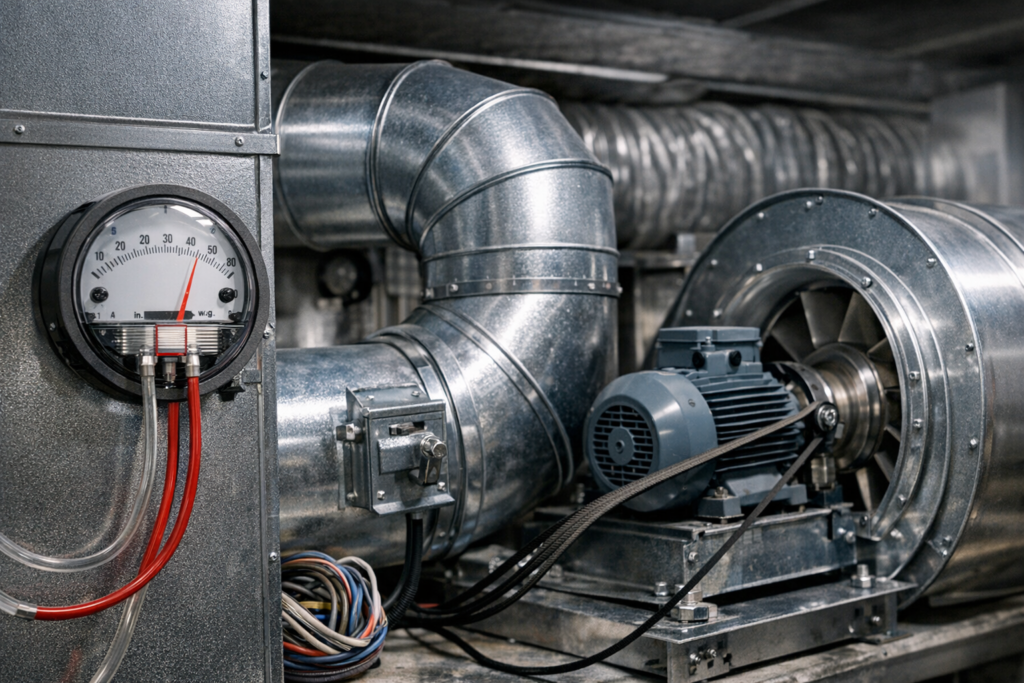
In the discipline of mechanical ventilation, static pressure is the invisible resistance that air must overcome to move through a system. If the fan is the heart of the HVAC system, static pressure is the “blood pressure” of the ductwork. Calculating this value accurately is the difference between a high-efficiency installation and a system that suffers from excessive noise, poor airflow, and premature motor failure. For technical offices and project managers, mastering these calculations ensures that the services align perfectly with the performance curves of the selected equipment. At AVENT PROJE, our about us highlighted engineering philosophy prioritizes precise pressure modeling to prevent the costly “safety margin” errors common in the industry.
The Physics of Resistance: Understanding Total and External Static Pressure
Static pressure is the outward push of air against the walls of the ductwork, measured in Inches of Water Gauge (in. w.g.) or Pascals (Pa). In a functioning system, we distinguish between Internal Static Pressure (the resistance within the AHU itself, such as coils and filters) and External Static Pressure (ESP), which is the resistance provided by the ductwork, diffusers, and dampers.
The engineering logic for calculation follows the principle that the fan must provide enough “Total Pressure” to overcome every obstacle in the airflow’s path. The core formula for calculating the required fan pressure is:
Total Static Pressure = External Static Pressure + Internal Static Pressure
In a typical field scenario, we often see fans that “underperform” despite meeting the specified RPM. This is frequently due to a failure to account for the “System Effect.” When a duct makes a sharp turn immediately after a fan outlet, the air becomes turbulent, creating a localized pressure spike that wasn’t in the original design. Accurate calculation requires a deep dive into the friction rates of every linear foot of ducting and the specific pressure drop coefficients of every fitting.

The Calculation Framework: Friction Loss and the Equivalent Length Method
The most common method for calculating ESP in commercial and industrial projects is the “Equal Friction Method.” This involves sizing the ductwork so that every section has the same friction loss per 100 feet of duct—typically 0.1 in. w.g. per 100 ft for supply ducts.
To find the total pressure drop for a run, engineers use the following steps:
- Identify the Longest Run: Find the path from the fan to the farthest diffuser with the most resistance (not necessarily the longest physical path).
- Calculate Linear Friction: Multiply the friction rate by the total length. Friction Loss = (Total Linear Feet / 100) × Design Friction Rate
- Add Component Drops: Sum the pressure drops for every device in that path, such as fire dampers, VAV boxes, and coils.
A common field reality in the Turkish HVAC market involves the addition of high-efficiency filters (like HEPA or MERV 13) after the initial design. If the technical office did not calculate the “Dirty Filter” pressure drop—the maximum resistance the filter will offer just before it needs replacement—the system will fail to deliver the design CFM within months of operation. Detailed guides on filter selection can be found in our technical blog section.
The Role of Fittings: Converting Geometry into Pressure Loss
Fittings like elbows, tees, and transitions are where most pressure is lost. Instead of calculating complex fluid dynamics for every turn, engineers use the “Equivalent Length Method.” This converts the resistance of a fitting into an equivalent length of straight duct. For example, a standard 90-degree elbow might have an equivalent length of 30 feet.
If a project manager ignores these fitting losses, the calculated ESP might be 0.5 in. w.g., while the actual site resistance is 0.8 in. w.g. This 0.3 in. w.g. discrepancy can cause a centrifugal fan to move 20-30% less air than required. In our specialized Industrial Ventilation projects, we utilize the ASHRAE Duct Fitting Database to ensure that every transition is modeled with the correct coefficient.
Critical Engineering Warnings:
- The Radius Matters: A “Short Radius” elbow can have triple the resistance of a “Long Radius” elbow. Always specify the turning vanes if space is tight.
- Flexible Duct Trap: Flexible ducts are convenient but have significantly higher friction than rigid galvanized steel. If “compressed” or kinked, the pressure drop can increase by 400%.
- Coil Wet/Dry States: A cooling coil has much higher resistance when it is wet (dehumidifying) than when it is dry. Always calculate static pressure based on the “Wet Coil” data.
Verification and Fan Curve Alignment
Once the total ESP is calculated, the final step is selecting a fan that intersects this pressure value at the required CFM. This intersection is the “Operating Point.” If the actual site pressure is higher than calculated, the operating point shifts to the left on the fan curve, resulting in lower airflow.
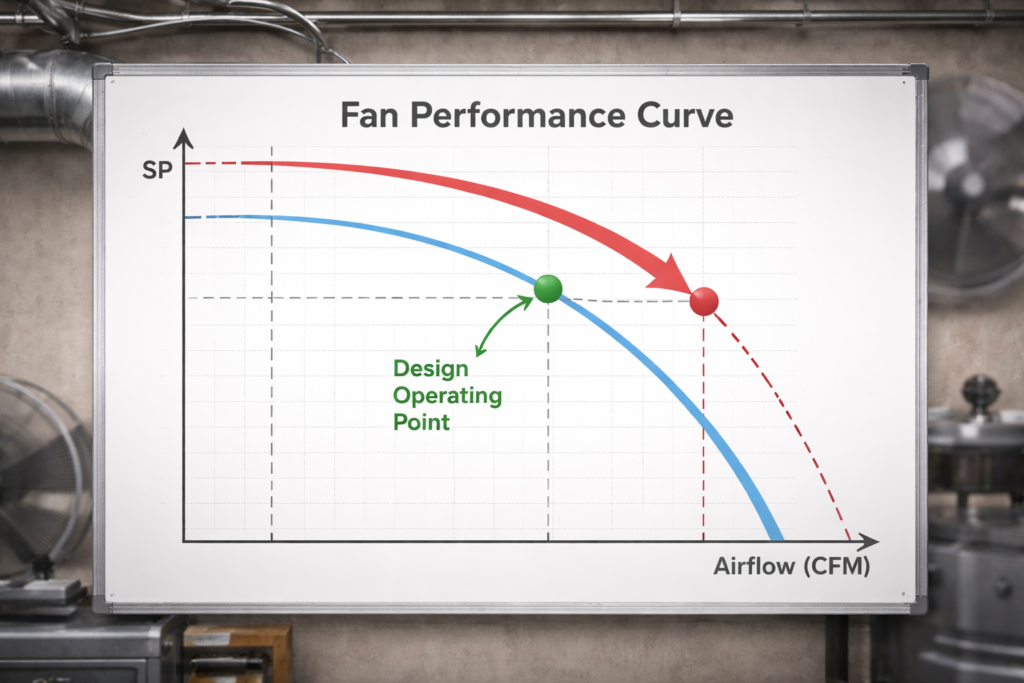
For large-scale projects, obtaining a professional get a quote for a detailed static pressure audit is essential. This prevents the “oversizing” of fans, which leads to high energy costs and acoustic issues.
Engineering Checklist:
- Critical Path Identification: Verify the path with the highest cumulative resistance has been identified.
- Fitting Factor: Confirm all elbows, tees, and dampers are accounted for using equivalent lengths or manufacturer coefficients.
- Dirty Filter Allowance: Ensure the design pressure includes the pressure drop of a loaded filter, not just a clean one.
- Safety Margin: Add a modest 5-10% safety factor to the ESP to account for site installation variances (but do not over-stack margins).
- Dynamic Pressure: Check if Velocity Pressure needs to be considered for high-velocity industrial exhaust systems.
Calculating static pressure is an exercise in detail. A system that is balanced on paper ensures a system that is quiet, efficient, and durable in the field. For technical assistance with duct sizing or fan selection for your next project, please reach out to our engineering team via our contact page.