

In the current global economic landscape, energy is no longer just a utility; it is one of the most significant operational expenditures for any industrial facility or commercial complex. Statistics often show that HVAC systems account for nearly 40% to 50% of a building’s total energy usage. For project managers and facility owners, the transition toward energy efficient ventilation systems is not merely an environmental gesture—it is a critical financial strategy to safeguard margins and ensure long-term sustainability. At the core of this transition lies the engineering discipline of balancing indoor air quality with the lowest possible electrical input.
Engineering the Foundation: Specific Fan Power (SFP) and System Efficiency
The primary metric for evaluating the efficiency of a ventilation design is Specific Fan Power (SFP). SFP measures the amount of electric power (W) used by the fan(s) to move a specific volume of air (m³/s). From a mechanical perspective, the lower the SFP, the more efficient the system. According to international standards like EN 16798-3, SFP levels are categorized from SFP 1 (highly efficient) to SFP 7 (highly inefficient).
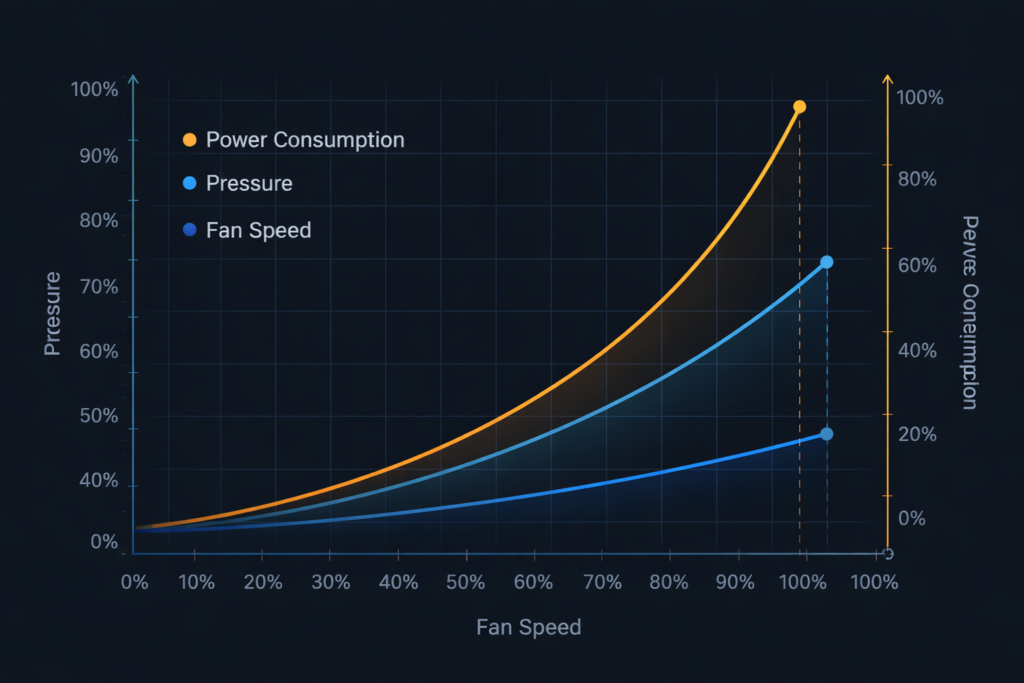
The engineering logic behind high SFP values usually points toward excessive pressure drops within the ductwork or poor fan selection. In our services phase, we emphasize that every extra Pascal (Pa) of resistance added by a sharp bend or a poorly sized filter forces the fan to work harder, exponentially increasing power consumption according to the “Fan Laws.” Specifically, power consumption increases by the cube of the fan speed; thus, even a small reduction in required pressure can lead to massive annual savings.
In typical industrial projects, we often encounter systems where fans are operating at fixed speeds regardless of the actual occupancy or pollutant levels. By integrating Variable Frequency Drives (VFDs) and CO2 sensors, the system can modulate airflow based on real-time demand. This “Demand Controlled Ventilation” (DCV) approach ensures that you aren’t paying to move air through an empty warehouse, directly impacting the bottom line.
The Role of Heat Recovery and Variable Flow Dynamics
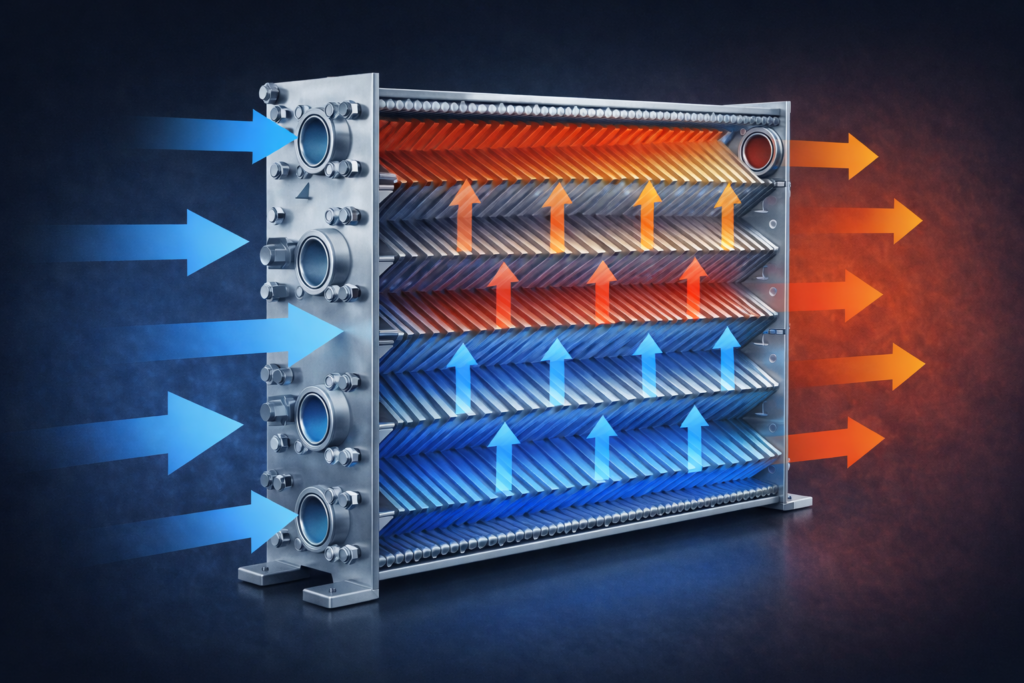
In climates like Turkey’s, where seasonal temperature shifts are significant, exhausting conditioned air directly to the atmosphere is a major source of energy waste. Heat Recovery Ventilation (HRV) or Energy Recovery Ventilation (ERV) units utilize a heat exchanger to transfer thermal energy from the outgoing exhaust air to the incoming fresh air.
Technical efficiency for these exchangers typically ranges from 60% to over 80%. For a technical office calculating the return on investment (ROI), the initial higher cost of an HRV unit is often recovered within 18 to 30 months through reduced heating and cooling loads. However, a common field reality is the neglect of the “pressure penalty.” A heat exchanger introduces resistance; if the exchanger is undersized to save space, the resulting increase in fan power might negate the thermal savings.
A scenario we frequently analyze involves industrial kitchens or workshops. Here, high-temperature exhaust can be repurposed via run-around coil systems or plate heat exchangers to pre-heat domestic water or intake air. In our blog section, we delve deeper into how specialized heat exchangers can handle corrosive or high-particulate exhaust streams without compromising longevity.
Field Integrity: Duct Sealing Classes and Maintenance Impact
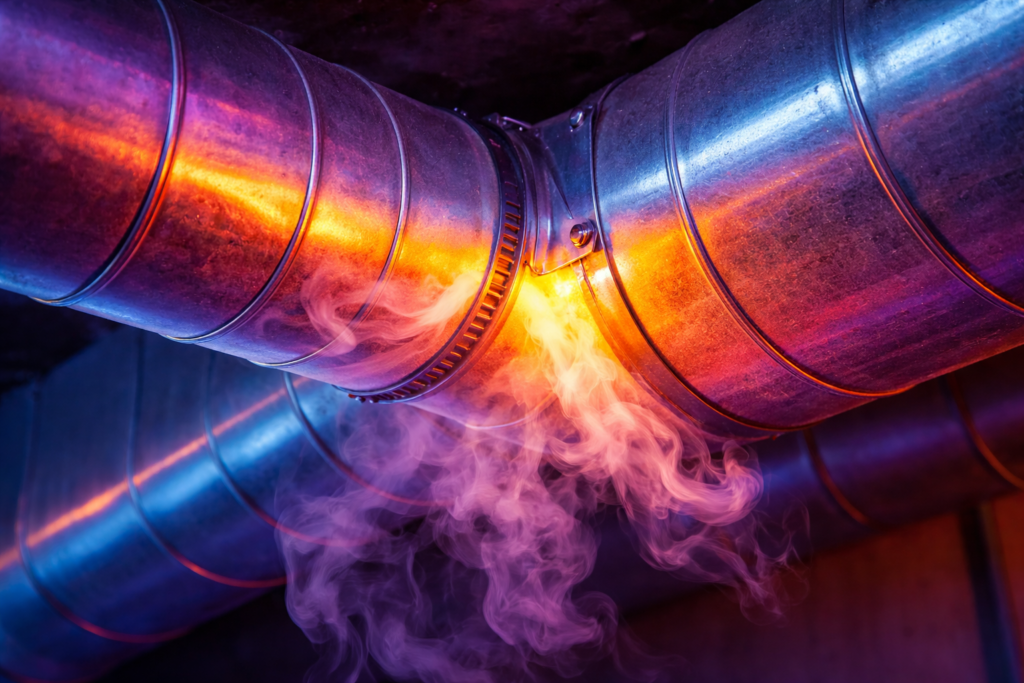
Even the most efficient fan becomes useless if the air it moves leaks out before reaching its destination. Air leakage in ductwork is a silent thief of energy. Standards define leakage classes from A to D, where Class C and D represent high-integrity systems suitable for energy-efficient designs.
In many construction sites, improper sealing at the joints of rectangular ducts leads to air losses of 15% to 25%. To compensate for this loss, the fan must run at a higher RPM, leading to increased noise and energy draw. Our about us highlighted engineering vision focuses on rigorous site supervision to ensure that ductwork installation meets Class C standards, utilizing high-quality gaskets and sealing compounds.
Critical Engineering Warnings:
- Over-Sizing Trap: A common error is “safety margin compounding,” where the designer, the contractor, and the supplier each add a 10% safety factor. This leads to a fan that is 30% larger than necessary, operating outside its peak efficiency curve.
- IE Rating Matters: Always specify IE3 or IE4 (Super Premium Efficiency) motors. While the price difference from IE1 is noticeable, the total cost of ownership over 10 years favors the higher efficiency motor by a wide margin.
- Filter Maintenance: A clogged filter can double the pressure drop in a system. Implementing differential pressure sensors that alert maintenance teams exactly when a filter needs changing—rather than on a fixed schedule—prevents unnecessary energy spikes.
Financial Logic: Life Cycle Cost (LCC) Analysis
When evaluating energy efficient ventilation systems, the “sticker price” is often misleading. Only about 15% to 20% of a fan’s total cost over 20 years is the initial purchase price. The remaining 80%+ is purely energy and maintenance.
Consider a typical office building scenario: A standard system might cost $50,000 to install but $15,000 a year to run. An optimized system might cost $65,000 to install but only $8,000 a year to run. In less than three years, the optimized system becomes the cheaper option. For a detailed breakdown of how we calculate these projections for your specific facility, you can request a technical get a quote.
Efficiency Commissioning Checklist:
- Verify the Fan Total Efficiency (ntot) is above 65%.
- Confirm the ductwork pressure test confirms Class C leakage or better.
- Ensure VFD parameters are tuned to the specific system curve, not just left at factory defaults.
- Check that bypass dampers are installed for heat recovery units to be used during “free cooling” periods in spring and autumn.
For corporations aiming to reduce their carbon footprint while simultaneously lowering utility bills, strategic mechanical design is the most effective lever. Our engineering team provides end-to-end consulting on these systems, from the initial concept to onsite verification. For direct inquiries, please reach out through our contact page.