
In the precise world of mechanical engineering, “adequate ventilation” is a target that can only be hit through rigorous calculation. Whether you are designing a high-tech cleanroom in Ankara or a commercial kitchen, the two fundamental pillars of airflow dynamics are CFM (Cubic Feet per Minute) and ACH (Air Changes per Hour). While they are often discussed interchangeably, they represent two different perspectives of the same system: one measures volume, while the other measures frequency. For project managers and technical offices, understanding how to balance these two metrics is the key to ensuring energy efficiency and regulatory compliance. At AVENT PROJE, our services are built on this mathematical foundation, ensuring every mechanical installation performs exactly as modeled in AutoCAD.
The Science of Volumetric Flow: Understanding CFM
CFM is the primary unit of measurement for the volume of air a fan or an air handling unit (AHU) moves through a specific point in one minute. In the engineering phase of any about us detailed project, CFM is the starting point for sizing ductwork and selecting equipment. The relationship between the physical size of the duct and the speed of the air is expressed through the fundamental formula:
CFM = Velocity (FPM) × Area (sq. ft.)
From an engineering standpoint, CFM is determined by the total heating or cooling load of a space. For example, if a server room generates 30,000 BTU/hr of sensible heat, the system must deliver a specific CFM of chilled air to maintain a stable 22°C. A common field error is “over-fan-ing”—selecting a fan with a higher CFM than the ductwork can handle. This leads to high static pressure, excessive noise, and localized turbulence that actually reduces the efficiency of the heat exchange.
The Efficiency Metric: Mastering Air Changes per Hour (ACH)
While CFM tells us how much air is moving, Air Changes per Hour (ACH) tells us how often the entire volume of air in a room is replaced. This is the primary metric for indoor air quality (IAQ) and contaminant dilution. In sensitive environments, achieving a high ACH is a legal and safety requirement.
The formula for calculating ACH is: ACH = (CFM × 60) / Volume of the Space (cu. ft.)
This calculation is vital during the mechanical projelendirme phase to ensure that pollutants—be it CO2 in an office or chemical fumes in a factory—are flushed out at a rate faster than they are generated. For instance, a standard office might require 4 to 6 ACH, whereas a sterile lab could require 30 to 60 ACH.
A frequent challenge in the Turkish construction sector involves “Dead Zones”—areas where the calculated ACH is achieved on paper, but poor diffuser placement leads to stagnant air. If the supply and return grilles are too close, the air “short-circuits,” moving from the supply to the exhaust without ever mixing with the room air. This highlights why professional balancing is essential for every blog topic we cover regarding system efficiency.
Placement: Directly under the “The Efficiency Metric: Mastering Air Changes per Hour (ACH)” heading.
Strategic Integration: Designing for Peak Performance
The true expertise in ventilation airflow calculation lies in the interplay between these two units. An engineer must calculate the CFM required for both the thermal load and the required ACH, then select the higher of the two values to ensure all criteria are met.
For example, in a large-volume warehouse, the thermal load might only require 2,000 CFM, but to achieve a safe 10 ACH for air quality, the system might actually need 5,000 CFM. Designing only for the thermal load would result in stuffy, poor-quality air, while designing only for ACH might lead to over-cooling if not managed by a Variable Air Volume (VAV) system.
In our technical office, we often encounter projects where the static pressure was ignored during the CFM calculation. As air moves through the filters and coils, resistance increases. If the fan curve isn’t perfectly aligned with the system’s static pressure, the actual delivered CFM will drop, subsequently crashing the ACH and failing the commissioning test. For a detailed equipment specification and system audit, you can always request a technical get a quote.
The Engineering Checklist for Airflow Validation
To ensure that your mechanical design translates perfectly to the field, use this checklist during the design and commissioning phases:
Engineering Checklist:
- Volume Accuracy: Confirm the net room volume by subtracting the volume of large equipment or structural columns.
- Static Pressure Margin: Ensure the CFM calculation accounts for the “dirty filter” state of the system.
- Duct Velocity Balance: Verify that branch duct velocities stay within 600–1,200 FPM to prevent acoustic issues.
- Standard Compliance: Cross-reference the calculated ACH with ASHRAE 62.1 or ISO 14644-1 for specific applications.
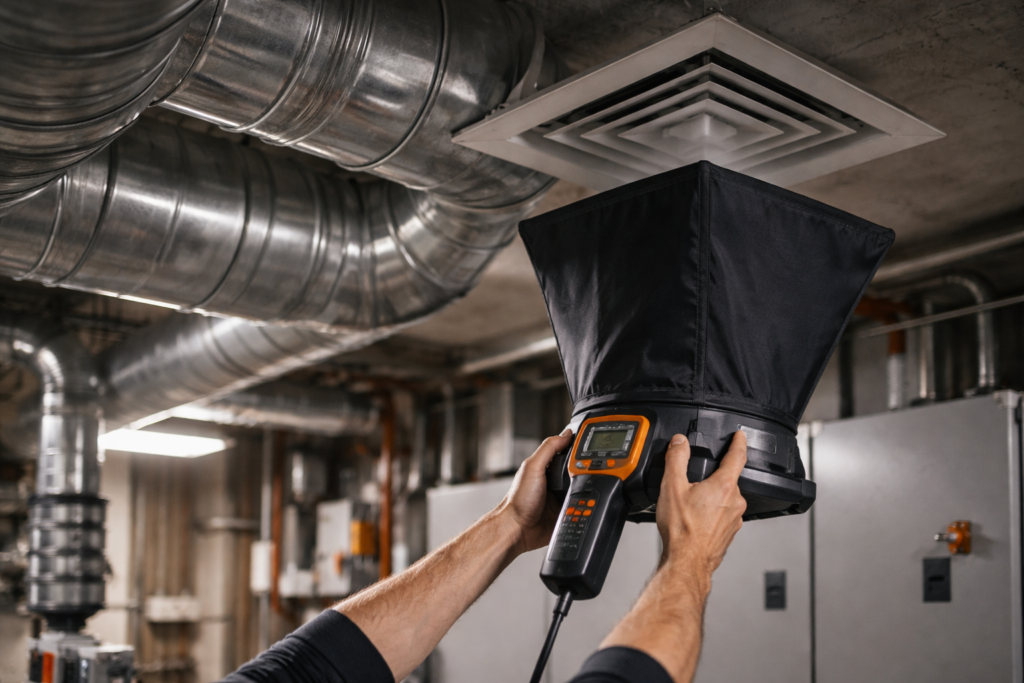
- Balancing Report: Require a final TAB (Testing, Adjusting, and Balancing) report to verify the CFM at every single diffuser.

The success of a ventilation system depends on the synergy between precise math and high-quality installation. Whether you are managing an industrial facility or a commercial high-rise, understanding CFM and ACH ensures that your building breathes correctly. For further technical support or to discuss your project requirements, our team is available through our contact page.