
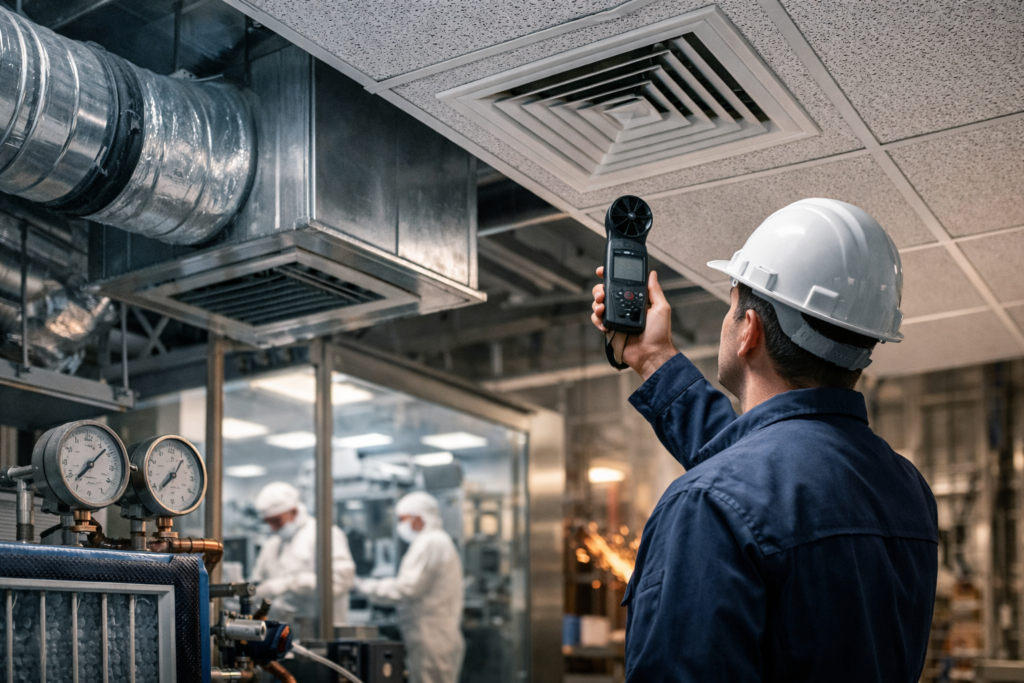
In the field of mechanical ventilation, providing “enough air” is a subjective goal unless it is backed by a rigorous mathematical framework. The primary metric used by engineers to quantify the effectiveness of a ventilation system is Air Changes per Hour (ACH). This value represents how many times the entire volume of air within a specific room or confined space is replaced by new, treated, or filtered air in a sixty-minute period. For technical offices and project managers, ACH is the baseline for ensuring occupant health, process safety, and compliance with international standards such as ASHRAE or local regulations. At AVENT PROJE, our about us highlighted engineering expertise focuses on translating these theoretical air turnover rates into high-performance mechanical realities.

The Mathematical Foundation of Air Turnover
To calculate the required airflow for a space, an engineer must first understand the relationship between the volume of the room and the volumetric flow rate of the HVAC equipment. The fundamental formula used in almost every mechanical projelendirme phase is:
ACH = (60 × CFM) / Volume of the Space (cu. ft.)
Alternatively, if you are working with metric units, the formula is: ACH = (3600 × Airflow in m3/s) / Volume of the Room (m3)
The engineering logic here is straightforward: to increase the ACH, you must either increase the supply airflow (CFM or m3/h) or reduce the effective volume of the room. However, simply achieving a high ACH number does not guarantee a healthy environment. It is the quality of the air being introduced—whether it is 100% fresh outdoor air or filtered recirculated air—that determines the true efficacy of the system. In our specialized services, we analyze the specific needs of a facility to determine the optimal balance between air volume and filtration levels.
In a typical field scenario, such as a large corporate meeting room, the design might call for 4 to 6 ACH. If the room is 500 square feet with a 10-foot ceiling (5,000 cubic feet), the system must deliver at least 333 CFM to reach 4 ACH. If the occupancy increases, the CO2 levels will rise rapidly. In modern “Smart Buildings,” we utilize Variable Air Volume (VAV) systems that sense these changes and automatically boost the CFM to maintain the target ACH, ensuring mental clarity for the occupants.
Standard Benchmarks: From General Offices to Industrial Zones
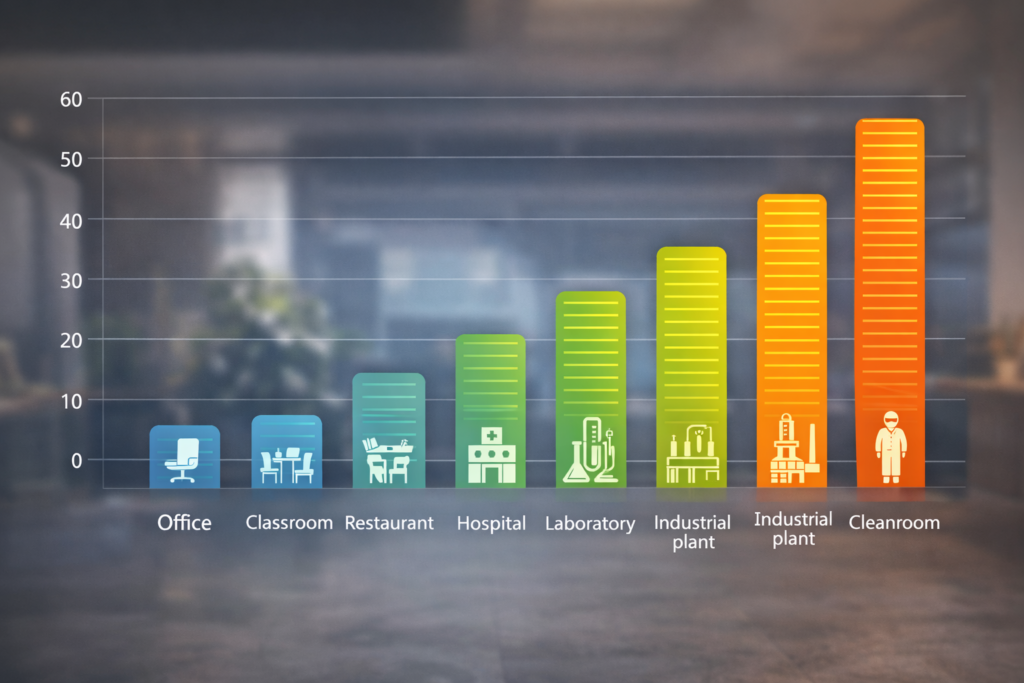
Not every room requires the same amount of air movement. The target ACH is determined by the function of the space, the number of occupants, and the presence of pollutants. Mechanical engineers refer to established standards (like ASHRAE 62.1 or ISO 14644) to set these benchmarks.
Typical ACH ranges include:
- Offices and Classrooms: 4–6 ACH
- Restaurants and Public Spaces: 6–10 ACH
- Hospital Patient Rooms: 6–12 ACH
- Industrial Workshops: 10–20+ ACH
- Cleanrooms (ISO Class 5): 240–480 ACH
The technical selection of fans and AHUs depends heavily on these targets. For example, in the Industrial Ventilation sector, high ACH values are required not just for comfort, but to dilute airborne particulates or hazardous gases. A frequent error observed in industrial warehouse projects is failing to account for “Internal Obstructions.” If a warehouse is packed with high-rack shelving, the effective volume of air is reduced, but the airflow patterns are significantly disrupted. In such cases, a theoretical calculation of 10 ACH might actually result in stagnant zones where pollutants accumulate.
Field Implementation and the Risk of Short-Circuiting
Achieving the design ACH on paper is one thing; verifying it in a live installation is another. One of the most critical risks in mechanical ventilation is “Short-Circuiting,” where the supply air travels directly to the exhaust port without mixing with the room air. This results in a high “theoretical” ACH but a very low “ventilation effectiveness.”
In the local market, particularly in older commercial buildings, we often find that HVAC systems were designed for lower occupancy levels. When these spaces are renovated into high-density offices, the original ductwork can rarely support the increased CFM required for a higher ACH without creating excessive noise and vibration. This is where a professional technical get a quote for a system audit becomes invaluable. Upgrading the fan power without resizing the ducts will only lead to high static pressure and increased energy costs.
Consider a scenario in a commercial kitchen: If the exhaust hood is extracting 2,000 CFM but the make-up air (MUA) system is only providing 1,000 CFM, the room enters a negative pressure state. The ACH calculation might look acceptable on the exhaust side, but the “missing” air will be pulled in through doors and windows, bringing in dust and unconditioned air. This unbalance ruins the climate control.
Engineering Checklist for ACH Verification
To ensure that your facility meets the necessary air turnover standards, technical offices should follow a rigorous commissioning process. Our team recommends the following steps:
Engineering Checklist:
- Volume Verification: Measure the actual room dimensions, subtracting the volume occupied by large, fixed equipment.
- Airflow Measurement: Use a balometer or anemometer to measure the actual CFM at every supply diffuser.
- Mixing Efficiency: Perform a smoke test to visualize airflow patterns and identify stagnant zones.
- CO2 Monitoring: In high-occupancy areas, track CO2 levels over a cycle to verify the ACH is sufficient during peak hours.
- Pressure Balancing: Ensure that the ACH is achieved while maintaining the correct pressure relationship relative to adjacent spaces.
The lifecycle of an HVAC system requires constant attention to these variables. As filters clog or fan belts slip, the delivered CFM will drop, directly reducing the ACH. Regular maintenance and recalibration are the only ways to ensure that the environment remains safe and compliant.
For projects requiring high-precision ventilation design or if you suspect your current system is failing to meet air change requirements, we invite you to consult with our engineers. A well-designed system pays for itself through improved health and productivity. For direct technical inquiries, please visit our contact page.